Mostrar mensagens com a etiqueta tecnologia. Mostrar todas as mensagens

sábado, julho 13, 2019

In My Language

O Video tem texto (legendado) incorporado, em inglês.
Foi criado com cuidado para ser inclusivo e a sua leitura ser acessível.
É uma criação impressionante, pelo conteúdo, pela forma e pelo processo.
"Há pessoas a morrer por serem consideradas não-pessoas"


IN MY LANGUAGEUSA2007(8.37 min)
This extraordinary short film by autism rights activist, Amanda Baggs, forces its neurotypical spectators out of their comfort zone. After showing her native language in part 1--the repetitive behaviors associated with autism (flapping her hands, playing with water, rubbing her hand on a fabric, rubbing her face on the inside of a book, clicking a stapler, rubbing metal against metal, etc.), which are accompanied by her own wordless humming of a haunting tune, she finally confronts us with the “Translation” in part 2. 
Using her keyboard voice-box as an augmentative communication device, she tells us in a computerized voice over that she has not presented these images merely to amuse us with a voyeuristic freak show but rather to explain that this is her native language and to ask us unsettling questions. Why is it, that in order to communicate with us, we assume it is only natural for her to learn our language whereas we are unwilling to learn hers? Why do we accuse her and other autistic individuals of refusing to interact with the world, when her native language clearly enables her to interact with everything in her environment? 
If we are unwilling to accept these repetitive gestures as a language, perhaps we should recall the writings of Russian theorist, Mikhail Bakhtin, who claimed in The Dialogic Imagination that whenever we encounter an alien discourse, it leads to “an ideological awakening” that makes us realize our own language is “only one among other cultures and languages,” which prevents us from naturalizing our own or any other single language as “the truth.”

In the epilogue to Nobody Nowhere: The Remarkable Autobiography of an Autistic Girl (1992), the first of the nine books that have made Australian writer Donna Williams one of the most well-known and highly respected persons with ASD in the world, she presents a list of gestures (similar to those demonstrated by Baggs) that she also considers “the more important language of `my world’.” Describing her own meanings and strategic uses of these gestures, Williams presents them, not as a provocative political stance like Baggs, but as helpful information for neurotypicals who want to understand and reach persons with autism “on their own terms.” As Stuart Murray points out in Representing Autism, “Listening to those with autism has never been a more available option, and it is one that those who are in the business of making cultural representations of the condition need to take up.” There is no better place to start than with Donna Williams’s Nobody Nowhere or Amanda Baggs' In My Language.

Marsha Kinderinhttp://www.interactingwithautism.com/section/understanding/media/representations/details/12

segunda-feira, janeiro 15, 2018

Bibliotecas & tecnologia, para quem?

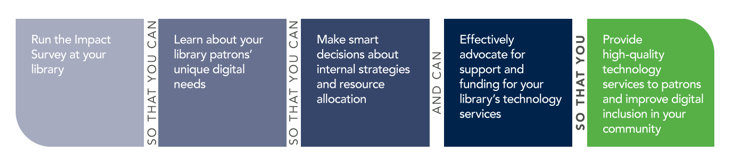
survey process

Investigação desenvolvida nos EUA a partir de 2013. Últimos resultados : 31.12.2017, aqui https://impactsurvey.org/sites/impactsurvey.org/files/cumulative_report.pdf

Este estudo apresenta um entendimento de como é que a oferta de serviços de acesso público à tecnologia beneficia cada comunidade. Para ajudar a sua biblioteca a usar efetivamente estes resultados nos seus esforços de advocacy, convidam-nos a visitar o sítio web do estudo e aí encontrar algumas ferramentas para argumentação (http://impactsurvey.org/advocacy). 

Um extracto dos resultados

In addition to use while traveling, research has shown that there are several other reasons that drive people with alternative means of access to use technology resources at the library: 
  • Lack of access to high speed Internet at home: Library Internet allows people to download large files or websites requiring a high speed connection. 
  • Gaps in access: Such as when moving or during power outages. 
  • Household competition: Especially among youth, competition with siblings or parents over a single household computer drives users to the library. 
  • A change of scenery: People who work at home sometimes use library computers and wireless to get out of the house. 
  • Job seekers also use computers in the library to maintain a normal schedule and stay connected to the community. 
  • During lunch breaks or while out running errands: People stop in to check email, look up phone numbers or directions, or other quick tasks. 
  • As a supplement to the library catalog: Users look up book reviews, reading lists, and other aids for selecting materials.

domingo, fevereiro 13, 2011

Bibliotecas são cada vez mais procuradas pelos jovens - Sol

Bibliotecas são cada vez mais procuradas pelos jovens - Sol

Impressiona a sinceridade da Coordenadora da investigação, que se confessa surpreendida por este resultados do estudo.
O potencial das bibliotecas na socialização é de há muito reconhecido, pese embroa não seja reflectido em muitas medidas políticas. Segurança passa sempre pela educação para a sociabilidade. Escolas sem bibliotecas, e sem bibliotecas com pessoal adequado, são escolas menos seguras, de crianças e jovens menos preparados(as) e mais... indefesos(as)!

sexta-feira, junho 12, 2009

Não há BOA tecnologia sem fracassos

You can't possibly get a good technology going without an enormous number of failures. It's a universal rule.
If you look at bicycles, there were thousands of weird models built and tried before they found the one that really worked. You could never design a bicycle theoretically. Even now, after we've been building them for 100 years, it's very difficult to understand just why a bicycle works - it's even difficult to formulate it as a mathematical problem. But just by trial and error, we found out how to do it, and the error was essential.
em entrevista (1998)
Mesmo assim,
dava jeito ir teorizando para melhorar a relação custo/benefício, não era?